
Cooking oil often leaves a translucent-looking patch rather than a bright colored spill. Food grease may arrive with sauces, dairy, or seasoning, making the mark harder to identify. Treat the event as a small investigation: what landed on the cloth, what the garment permits, and what a laundry product actually instructs. This guide covers washable everyday fabrics, not industrial oil contamination or professional-care garments.
Describe the grease before choosing a product
Record whether the mark came from plain cooking oil, butter, mayonnaise, or a mixed meal. Also note whether it was fresh when discovered or has already been through a wash. That description is useful when asking a manufacturer for advice and prevents you from treating every dark patch as the same stain. An old discolored area may not be removable grease at all.
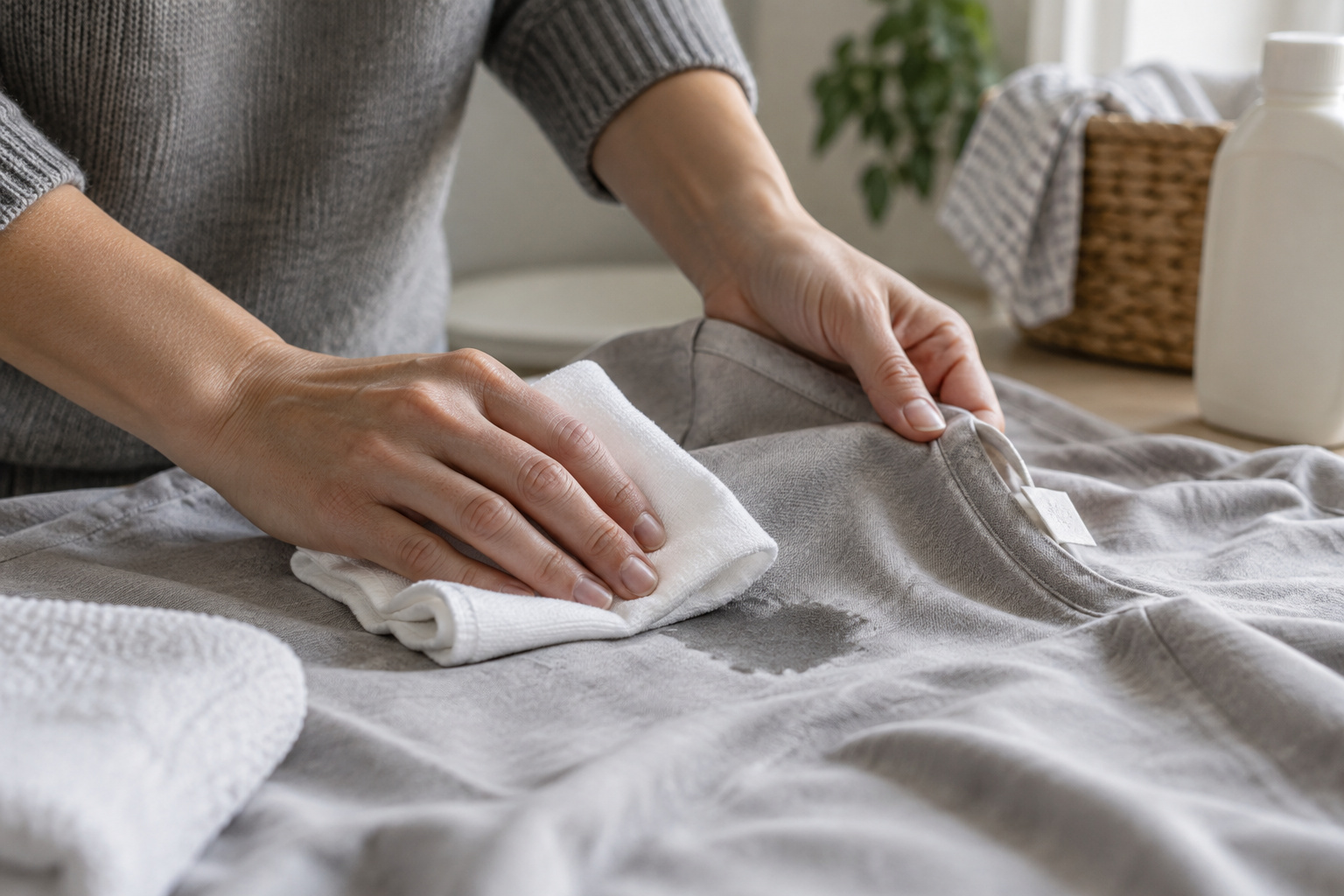
Keep the affected garment apart from other laundry until you have made a plan. Lift loose surface food carefully without pressing it into the textile. Avoid spreading the spill across a wider area with repeated wiping. Do not pour a kitchen degreaser or household solvent onto clothing merely because its packaging mentions grease; its permitted surfaces and intended use may be completely different.
Use both labels as the first filter
Read the garment care label, the stain treatment label, and the testing directions before applying anything. Perform a material spot test on an inconspicuous representative area and check the result after the directed rinse and drying step. Stop for color transfer, a changed finish, or texture damage. Our care-label guide gives a practical order for these checks.
A washable apron and a structured jacket are not equivalent even when their labels list a similar fiber. The FTC care-label guidance emphasizes instructions for regular care and warnings against harmful procedures. If the proposed treatment conflicts with those instructions, choose another supported route or seek professional advice. White fabric is not automatic permission for bleach, hotter water, or prolonged soaking.

Follow a laundry pretreatment route
The ACI stain guide recommends a prewash stain remover for butter and mayonnaise, followed by laundering within the fabric's temperature limits. Use that as a reason to investigate a labeled laundry pretreatment, not as proof that every oil stain will respond to the same formula. Look for instructions covering the stain and textile you actually have.
Apply the product as directed, including the required quantity and contact time. Do not let a treatment remain on the fabric overnight unless that use is expressly supported. Do not substitute dishwashing liquid on the assumption that all grease cleaners work identically in a washing machine. If the product instructions are missing or unclear, find the manufacturer's guidance before applying it. Product strength is not a useful substitute for a complete use instruction.
Handle a mixed food stain without stacking chemicals
A cooking stain may combine oil with tomato, dairy, or another food. Make a note of the mixture instead of constructing your own mixture of cleaners. Select one labeled treatment that addresses the known spill and meets the garment restrictions. If a dairy component leads you to consider an enzyme-containing product, check the enzyme stain remover guide and the exact formula's exclusions first.
Never mix cleaning products in a bowl or on the stain. The Washington Department of Health warns against bleach mixed with ammonia, acids, and other cleaners. This matters when a kitchen spill tempts someone to add vinegar or another household remedy after a laundry chemical. Unknown residue from a previous treatment is another reason to pause and clarify what has already been used.
Let the care label set the wash temperature
Advice to use the hottest water safe for a fabric still contains an essential limit: safe for that specific garment. It does not mean the hottest program on the appliance. Follow the garment label and the chosen product directions together. If the product requires conditions the garment cannot tolerate, it is a poor match, regardless of the stain type.
Wash using the appropriate cycle and dosing instructions, then examine the affected area before drying. Look from different angles because a grease mark can be subtle. Compare with nearby unmarked fabric rather than deciding from a single glance. Do not iron the area to see whether it disappears. If a residual mark remains, preserve your options by following a permitted drying method and reassessing the treatment.
Decide whether a second attempt has a purpose
The ACI recommends repeating stain treatment when needed and avoiding the dryer while a stain remains. A second attempt is most useful when you can state what the first did: the patch shrank, the outline faded, or a colored component remains. Repeat only within the product instructions. Increasing concentration or rubbing harder is not a controlled improvement.
For an already dried mark, read the set-in stains and drying guide before escalating. Stop if the textile changes, there is no meaningful progress, or you cannot identify the previous treatment. Keep a record for garments frequently exposed to cooking spills. A washable work apron can be a practical way to reduce future exposure, but no accessory changes the limits on treating the garment underneath.